Conflicting Court Rulings Undermine Nigeria's Judiciary Amid Independence Celebrations
As Nigeria marks its 66th independence anniversary, the judiciary faces scrutiny over conflicting court rulings that threaten its integrity and public trust.



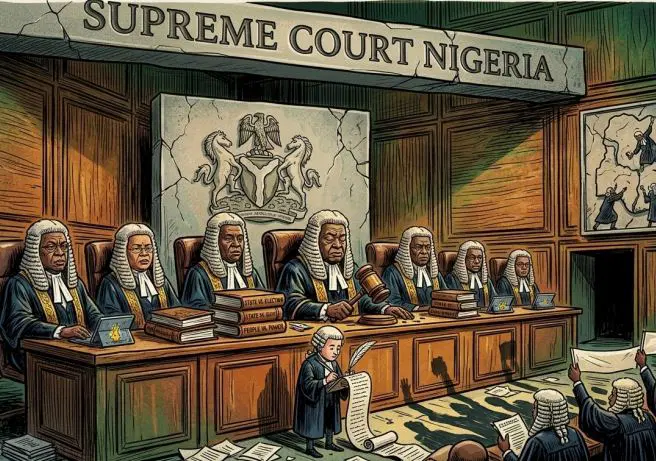
As Nigeria celebrates its 66th independence anniversary, the judiciary is under intense scrutiny due to a series of conflicting court rulings that have raised concerns about the integrity and credibility of the legal system. Recent cases, particularly in Kano State and Rivers State, highlight the troubling trend of divergent judicial orders that leave citizens and law enforcement agencies grappling with uncertainty.
The National Judicial Council (NJC) has taken note of these issues, particularly in light of the ongoing Kano Emirate crisis. In May 2024, conflicting orders emerged from the Federal High Court and the Kano State High Court regarding the chieftaincy dispute involving Muhammadu Sanusi II and Aminu Ado Bayero. Justice A.M. Liman of the Federal High Court issued an ex-parte order halting the implementation of the Kano State Emirate Council (Repeal) Law, while Justice Amina Adamu Aliyu of the Kano State High Court ordered security agencies to refrain from removing Sanusi from his position. Just days later, another ruling from Justice S.A. Amobeda of the Federal High Court directed the police to ensure Bayero's rights as Emir, further complicating an already tense situation.
This legal confusion is not limited to Kano. The Rivers State political landscape has also been marred by conflicting judicial decisions. On September 30, 2024, the Rivers State High Court ordered the Rivers State Independent Electoral Commission to proceed with local government elections. However, concurrent proceedings in the Federal High Court in Abuja issued contradictory orders, showcasing the contentious nature of political disputes and the potential for judicial rulings to influence electoral outcomes.
The Body of Senior Advocates of Nigeria (BOSAN) has expressed alarm over the persistence of conflicting decisions at the highest levels of the judiciary. During the opening of the 2025/2026 legal year, BOSAN highlighted the need for a thorough review of the Supreme Court's decisions, citing cases such as Okafor v Nweke and Olowe v Aluko, which have led to confusion regarding legal principles. The organization has called for a meeting of justices from the Supreme Court and Court of Appeal to address these inconsistencies.
Judicial precedent, or the doctrine of stare decisis, is intended to provide clarity and consistency in legal rulings. However, the recent spate of conflicting judgments undermines this principle, leaving litigants and the public unsure of what the law dictates. Justice Musa Dattijo Muhammad emphasized the need for certainty in adjudication, a sentiment echoed by legal experts who argue that conflicting rulings can escalate disputes beyond the courtroom and into the public sphere.
As Nigeria reflects on its journey since independence, the judiciary's ability to maintain its credibility hinges on its capacity to deliver consistent and clear rulings. The current climate of conflicting judgments poses a significant threat not only to the rule of law but also to public confidence in the judicial system. It is imperative that the judiciary addresses these challenges to restore faith in its authority and ensure that justice is served uniformly across the nation.
Sources
- Vanguard News Original article