Nigerian market traders challenge perceptions of wealth with surprising stories
A woman's observations about market traders' financial success raise questions about wealth.


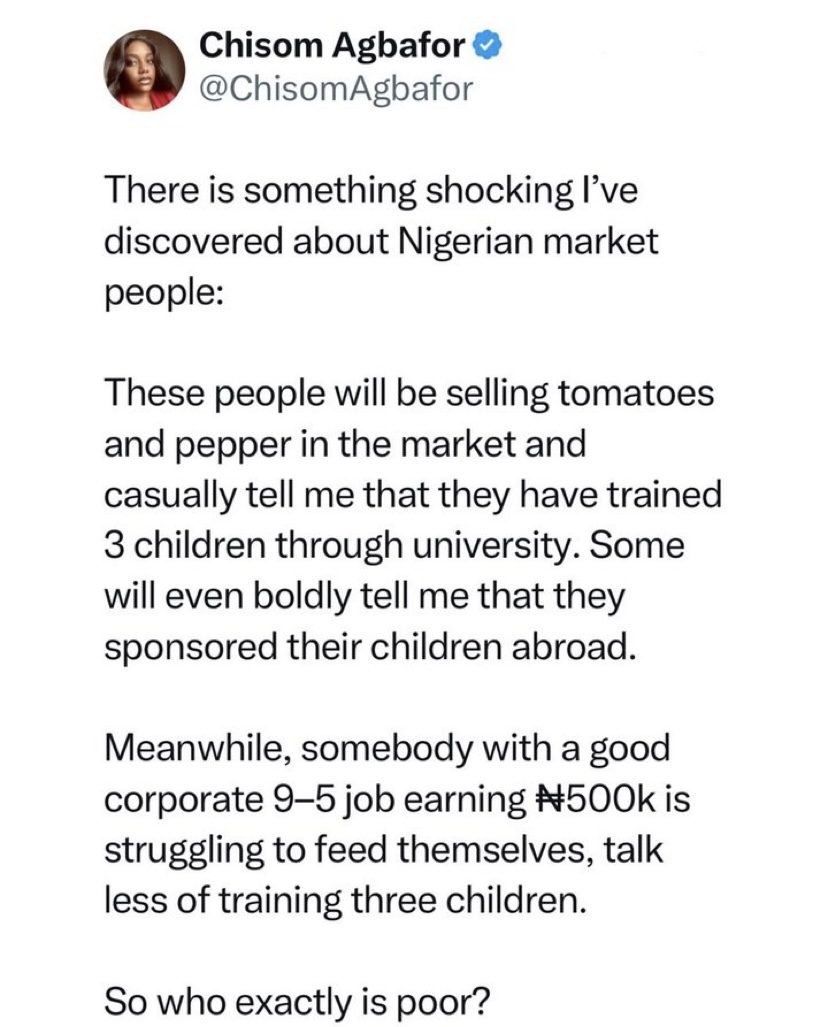
A recent social media post by a Nigerian woman has ignited a conversation about the financial realities of market traders compared to corporate workers in Nigeria. The woman, known on X as @ChisomAgbafor, shared her astonishment at the financial achievements of some market women, who, despite selling everyday items like tomatoes and peppers, have managed to fund their children's education, including sending them abroad for studies.
In her post, Chisom recounted her interactions with these traders, revealing that many of them have successfully trained multiple children through university. She expressed her surprise when some traders casually mentioned their accomplishments, stating, "These people will be selling tomatoes and pepper in the market and casually tell me that they have trained 3 children through university. Some will even boldly tell me that they sponsored their children abroad."
Chisom's observations prompted her to reflect on the broader implications of wealth and poverty in Nigeria. She noted that while some individuals in corporate jobs earn substantial salaries, they often struggle with basic living expenses. "Meanwhile, somebody with a good corporate 9-5 job earning A$500k is struggling to feed themselves, talk less of training three children. So who exactly is poor?" she questioned.
This perspective has resonated with many online, as it challenges the conventional understanding of financial stability. The discussions highlight a significant disparity in how wealth is perceived across different sectors of the economy. While market traders may operate in what is often viewed as a low-income environment, their ability to support their families and invest in education suggests a different narrative about financial success.
The conversation initiated by Chisom has brought to light the resilience and resourcefulness of market traders in Nigeria, who navigate economic challenges while providing for their families. It raises important questions about the metrics used to define poverty and wealth, encouraging a reevaluation of societal norms regarding financial success.
As this dialogue continues to unfold on social media, it serves as a reminder that financial well-being can manifest in various forms, often defying traditional expectations and stereotypes.
Sources
- Gistreel Original article