The boys with a rifle: The warning Nigeria cannot ignore
A disturbing video has been circulating on social media. In it, a teenage boy claims that he and about 30 other teenagers have been undergoing military-style weapons training inside a thick forest alo



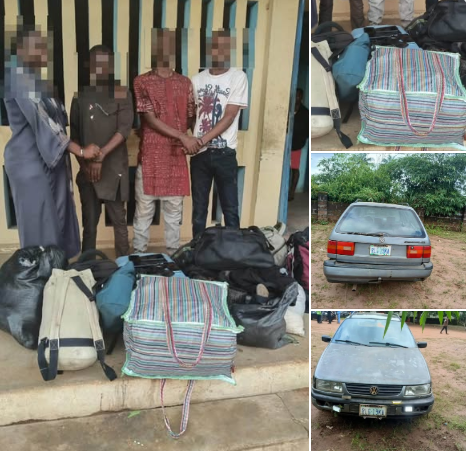
A disturbing video has been circulating on social media. In it, a teenage boy claims that he and about 30 other teenagers have been undergoing military-style weapons training inside a thick forest along the Adamawa-Borno axis. To test the credibility of his account, he was reportedly handed a rifle and asked to dismantle and reassemble it. He did so with a level of confidence and precision that would surprise many adults. This scenario is of course not new. In December 2021, the Adamawa State Police Command arrested a 16-year-old boy, Sunza Samuel, for unlawfully carrying a pistol and other firearms. In March this year, tension rose in Borno State following the circulation of a viral video showing 18 underage children in military-style uniforms celebrating in an isolated forest. At the time, the Borno State Commissioner for Women Affairs and Social Development, Zuwaira Gambo, said the children could be victims who were forcefully taken during recent attacks. Indeed, a 2024 UNICEF report indicated that over 8,000 children had been recruited by Boko Haram and thousands more affected by terror-related violence and exploitation in northern Nigeria. Thus, whether one focuses on the current video itself or not, the larger question it raises should concern every Nigerian. How does a child become proficient in handling a weapon of war? How does a teenager acquire skills that are normally associated with trained military personnel? More importantly, what kind of society produces a situation where a child becomes familiar with a rifle before becoming familiar with the opportunities that education and productive employment can offer?
For years, Nigeria has treated insecurity primarily as a military problem. It discusses bandits, terrorists, kidnappers, and armed gangs as though they emerged from nowhere. It focuses on the men carrying the guns but pay less attention to the conditions that continually replenish their ranks. Yet every criminal network, every insurgent group, and every violent movement depends on one thing above all else: a steady supply of recruits. Across large parts of northern Nigeria, millions of young people remain trapped in a cycle of poverty, illiteracy, unemployment, and hopelessness. Too many children are outside the formal education system. Too many young men and women possess neither vocational skills nor realistic economic prospects. Too many communities have watched opportunities disappear while criminal networks expand. Under such circumstances, vulnerable youths become easy targets for recruitment, manipulation, and indoctrination. This is why the importance of education cannot be overstated. Every skill acquired is a barrier against extremism. Every functioning school is a security investment. Unfortunately, while governments have spent years talking about these challenges, the situation has continued to deteriorate. Politicians have held conferences, issued communiqués, launched initiatives, and made promises. Yet vast numbers of young people remain idle and disconnected from meaningful opportunities.
Equally troubling is the question of arms proliferation. To defeat the climate of terror that has enveloped many parts of Nigeria, the government must confront the reality that criminals have gained alarming access to weapons. Bandits move across forests carrying sophisticated firearms. Terrorists conduct coordinated attacks. Kidnappers operate over vast territories. The obvious question is: where are these weapons coming from? Successive governments have spoken for years about curbing the proliferation of small arms and light weapons. Yet the problem appears to be growing rather than diminishing. This raises serious questions about the effectiveness of the institutions charged with addressing the challenge. The agency responsible for combating small arms proliferation must be subjected to honest scrutiny. Nigerians deserve to know not only how many weapons have been seized but also how many traffickers have been identified, prosecuted, convicted, and imprisoned.
One of the most frustrating aspects of the arms proliferation crisis is the apparent absence of accountability. Weapons are occasionally intercepted. Arms caches are sometimes discovered. Press statements are issued. Headlines are generated. Then the story disappears. Rarely do Nigerians hear of the complete criminal networks behind those weapons being dismantled. Every weapon seized has a supplier, a financier, a transporter, and an intended recipient. Unless those networks are exposed and punished, the cycle continues. The Nigeria Customs Service (NCS) must intensify efforts to curb the smuggling of arms through the country's porous borders and ports. Corruption within the system, wherever it exists, must be confronted decisively because weapons do not cross borders by magic. They are moved by people and facilitated by networks that exploit weaknesses in enforcement mechanisms. The Nigeria Immigration Service (NIS) must also strengthen its capacity to identify and intercept dangerous elements entering the country. Nigeria's security challenges are increasingly interconnected with regional and transnational criminal activities. Effective border control is therefore no longer simply an immigration issue; it is a national security imperative. The management of the nation's ports must equally wake up to the gravity of the challenge. Ports are gateways for commerce and development, but they can also become gateways for insecurity if vigilance is compromised. Every container that enters Nigeria must be viewed through the lens of national security as well as economic activity.
Beyond border agencies, intelligence institutions must raise their game. The Department of State Services and the National Intelligence Agency have critical roles to play in identifying, tracking, and disrupting the networks that finance, supply, recruit, and coordinate violent actors. Modern security challenges cannot be solved solely through force. They require intelligence, foresight, infiltration, and the ability to dismantle criminal structures before they mature into larger threats. At the political level, northern governors, in particular, must recognise the urgency of the moment. The challenge before them is not merely one of law enforcement; it is a struggle for the future of an entire generation. They must intensify efforts to dismantle criminal networks operating within their domains, regardless of the religious, ethnic, ideological, or political banners under which such groups attempt to hide. Criminality must never be confused with faith, and violence must never be excused by ideology.
The most disturbing aspect of that teenager's demonstration is not that he knew how to dismantle and reassemble a rifle. It is that somewhere along the line, a child found access to a weapon more readily than access to opportunity. That should trouble the conscience of the nation. The boy in that video is more than an individual; he is a symbol of a deeper national failure. He represents years of neglected education, youth unemployment, weak border controls, unchecked arms proliferation, inadequate intelligence, poor prosecution of offenders, and the slow pace of security reforms. Above all, he represents a warning. The future of Nigeria may well depend on how seriously it responds to that warning.
- tribuneonlineng Original article